


01/12/2025
How to Teach Young Footballers to Compete Without Comparison
Competition is healthy. It pushes kids to test their limits and discover their true capabilities. But comparison? It makes them feel small. It turns teammates into measuring sticks and every practice into a test of whether they’re “enough.”
In this blog, we’ll look at why comparison creeps in, what it does to young players, and how to help your child compete with fire while keeping their confidence intact.
Why Young Players Start Measuring Themselves Against Other Players
Most parents think they’re motivating their kids when they use competitive language. But they’re actually teaching them to measure their value against others.
The truth is, comparison isn’t something kids are born with.
Kids under 6 or 7 don’t naturally compare themselves to others. Their world is internal. They’re focused on mastering fundamental football skills like learning how to dribble or how to control a pass. They’re not thinking about whether they’re better or worse than the child next to them.
But around age 9 or 10, they become more aware of how others see them. They start noticing who gets praised at the football academy, who scores more, and who the coach favours.
And that’s when comparison begins.
What’s worse?
Parents and coaches accidentally accelerate it.
When a parent casually asks, “Did you win?” instead of “What did you work on today?” Or when a coach high-fives only the player who scored goals and ignores the one who made 15 accurate passes. These small moments teach kids that outcomes matter more than effort, and thus, comparison takes root.
What Happens When Young Players Start Comparing
There are two types of goal orientations in sports.
1. Task/Mastery Orientation Players
These players ask themselves, “Am I better than I was yesterday?”
They bounce back from mistakes because failure isn’t judgment; it’s feedback. They stay in the game longer and enjoy the process. This kind of resilience in football shapes not just better players, but confident kids who don’t give up easily. At BFC Soccer Schools, widely recognised as one of the best football academies in India, our coaches encourage this mindset by praising effort over outcomes and creating a space where mistakes are simply part of getting better.
2. Ego/Performance Orientation Players
These players ask, “Am I better than them?”
They tie their self-worth to where they rank. They avoid challenges because what if they fail in front of others? What if someone sees them struggle? When they face a more skilled player, they crumble (or worse, they quit). Research shows that athletes with high ego orientation and low task orientation experience fear of failure and are more likely to perceive challenging situations as threatening rather than growth opportunities. This mindset prevents them from experiencing the benefits of football competition that come from pushing their own limits.
The good news?
You can help players shift from comparison to growth. It starts with something simpler than you’d think: the words you use every single day.
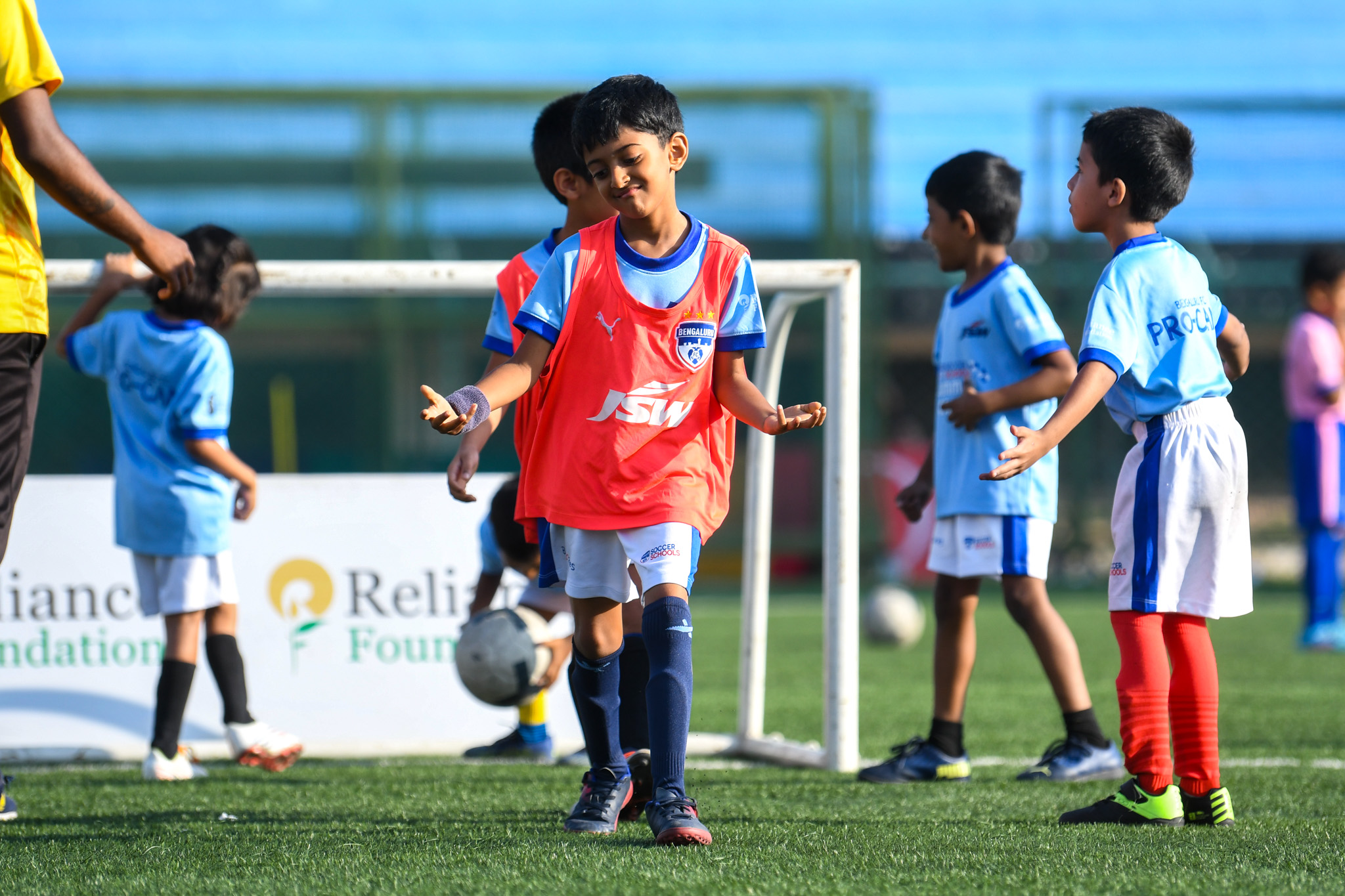
How to Talk to Your Child About Football: Do’s and Don’ts
The questions you ask and the praise you give don’t just reflect your values. They actively shape whether your child chases self-improvement or constantly compares themselves to teammates. This is what being a sporting parent means. Now, here are the phrases to avoid, and what to say instead:
What Not to Say to Your Child After Football Practice
❌ “You’re so much better than your teammates” – This creates ego-driven confidence that shatters the moment they meet someone more skilled.
❌ “Why can’t you be like [other kid]?” – This teaches them their value is relative and they’re only good if they measure up to others.
❌ “Who scored the most goals today?” – This makes them hyper-aware of rankings and turns football into a competition against teammates.
What to Say to Your Child After Football Practice
✅ “Look how much you’ve improved since last month” – This helps them measure progress against themselves, not against others.
✅ “What did you learn today?” – This shifts focus from rankings to growth.
✅ “What made you proud today?” – This encourages reflection instead of comparison and shifts focus inward.
But to truly help your child build lasting confidence and unlock the benefits of football competition, there’s one more thing they need to learn: how to set the right kind of goals.
Recommended Reading:
Want more guidance on this kind of positive football parenting? Read our blog on handling wins and losses.
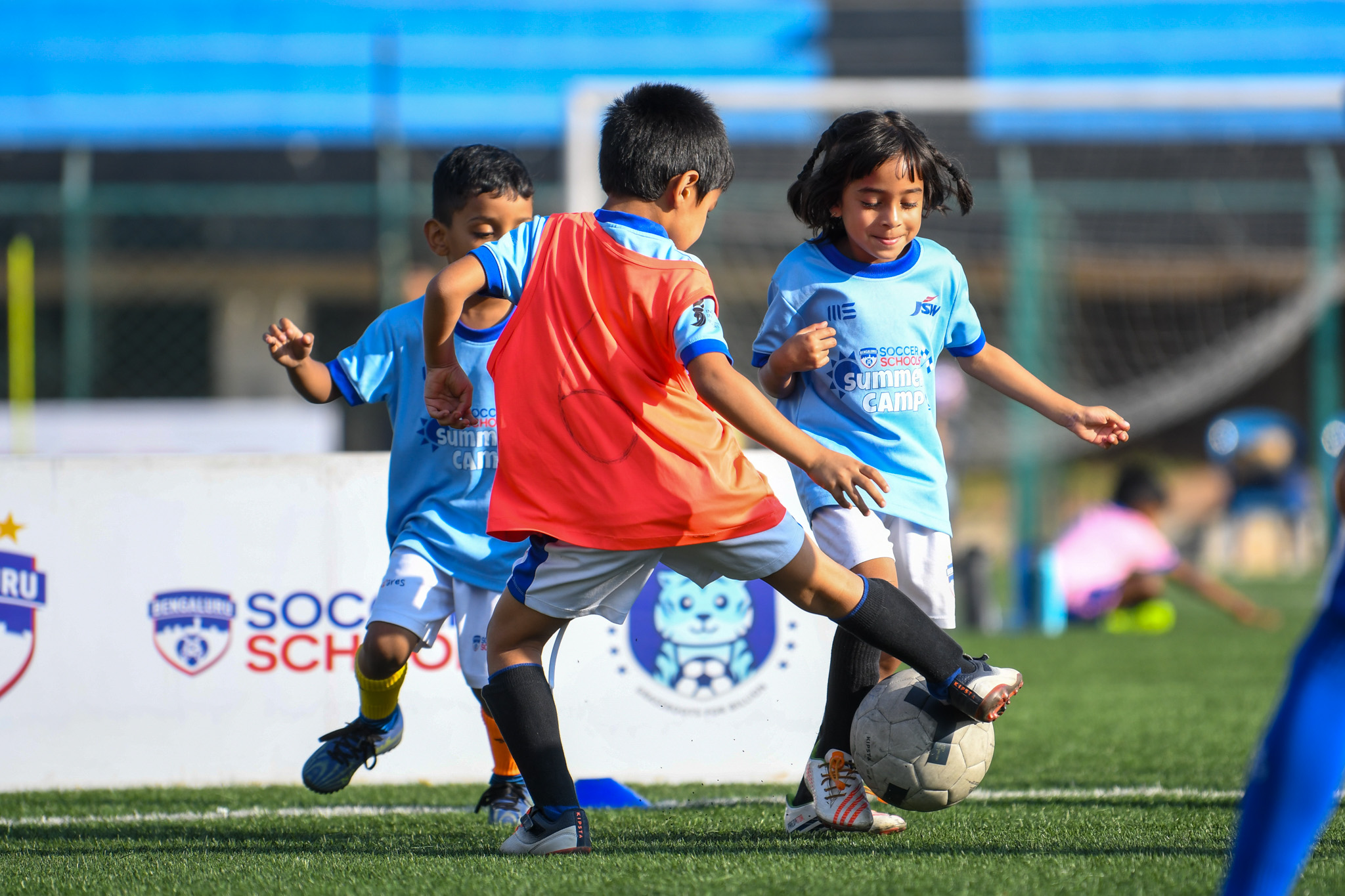
How to Set Goals That Build Confidence (Not Comparison)
According to neuroscience, our brain learns through repetition. Every time a young player practices a movement with focus or tries again after a mistake, the brain strengthens that pattern. Over time, these small actions build progress. But when players start obsessing over outcomes instead of their habits, they feel pressured or “not good enough.” Learning to manage this pressure early helps them perform better under stress and play with confidence.
So how does this apply to football?
It starts with understanding the difference between two types of goals: outcome goals and process goals.
Outcome goals focus on the final result, things like:
-
-
- Scoring the most goals in the match
- Getting selected for the starting lineup
- Winning the tournament or beating a specific team
-
Process goals are focused on actions and decisions a child can control during the game, for example:
-
-
-
- Making five clean first touches
- Tracking back to defend after every lost ball
- Attempting three dribbles or turns, they’ve been practising
-
-
Outcome goals depend on things outside a child’s hands. Process goals depend entirely on what they choose to do. That’s why process-based goals work better for young players. They keep kids focused and motivated. And most importantly, they help children experience improvement every single time they step on the pitch—even if the score doesn’t go their way.
At BFC Soccer Schools, our football coaching in Bengaluru helps young players set process-based goals during training. Our coaches focus on controllable actions like improving first touch or tracking back, so players can grow with every game (regardless of the score).
Conclusion: Raise a Competitor, Not a Comparer
Competition pushes your child to grow. Comparison holds them back. The difference lies in what you say, how you praise, and the goals you help them set. When kids learn to measure success against their own progress (not against their teammates), they build unshakable confidence that lasts far beyond the pitch. That’s how football builds confident kids and unlocks the true benefits of competition for kids: resilience and self-belief.
At BFC Soccer Schools, this is exactly what we do. Our coaches don’t just train players to score goals; they create an environment where effort is valued, mistakes are part of learning, and every child’s growth matters. If you want your child to develop skills and a love for the game that goes deeper than winning, join a free trial session and experience the difference.
Remember: the goal isn’t perfection. It’s progress. And that starts the moment they step on our pitch.
Recent Posts
02/06/2026
What Should Your Child Carry to a Football Camp? A Simple Packing Checklist
29/05/2026
How to Prepare Your Child for a Football Trial or Selection Camp
19/05/2026
The ABCD of Receiving the Ball: What Every Young Footballer Needs to Know
Testimonials







FOLLOW US


DOWNLOAD APP


QUICK LINKS
OFFICIAL KIT PARTNER

FOLLOW US
DOWNLOAD APP
GET IN TOUCH
ADDRESS:
Raheja Towers (East), 6th floor, # 26-26, M.G Road, Bangalore, Karnataka, India 560001
Call Us:
